

The cost of this misalignment extends beyond politics and erodes the strength and perception of the Igbo brand itself — Dr. Anthony Ogbo
Few ethnic groups in the modern world embody resilience, adaptability, and entrepreneurial drive like the Igbo of southeastern Nigeria. Forged by history, particularly the trauma and aftermath of the Nigerian Civil War, the Igbo spirit has evolved into a global force defined by education, commerce, and labor. Across Africa, Europe, Asia, and the Americas, Igbo professionals, traders, academics, and innovators have exerted disproportionate influence. Their philosophy of self-determination, “Igbo enwe eze” (the Igbo have no king), has fostered a decentralized, merit-driven culture that rewards initiative and hard work.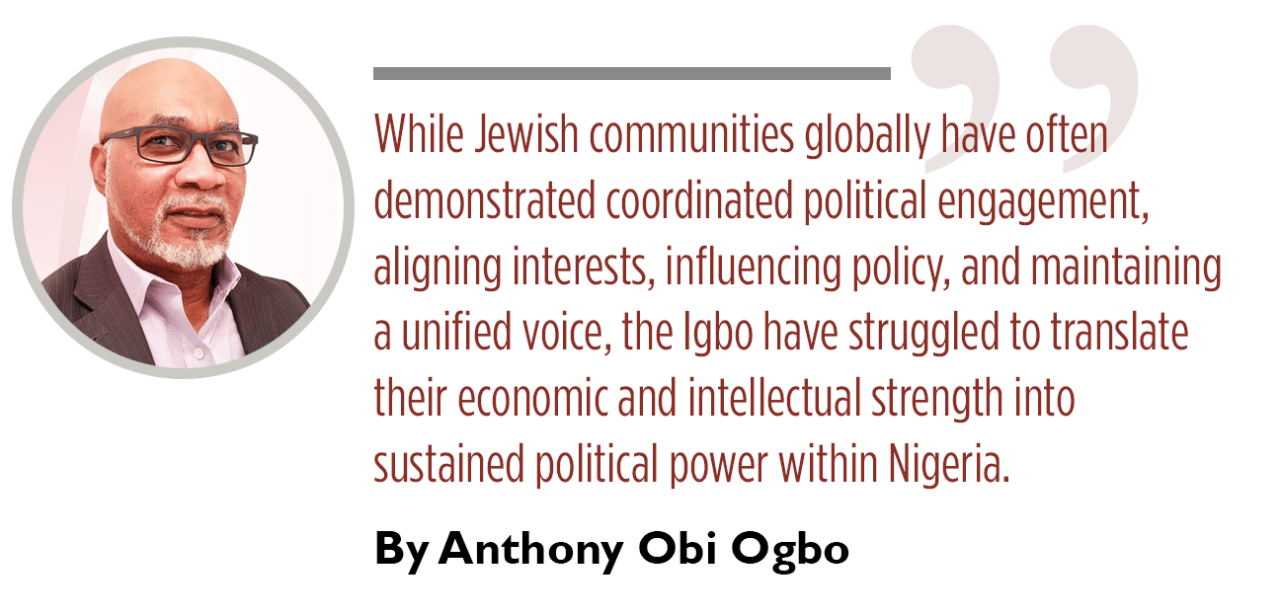
In many respects, this dynamism mirrors that of the Jewish people. Like the Jews, the Igbo have leveraged education as a primary tool of advancement, often placing extraordinary value on academic achievement as a pathway to mobility. In commerce, both groups demonstrate remarkable networking capabilities, building trust-based systems that transcend geography. In labor, their willingness to start from the margins and climb through persistence is widely documented. These parallels are not superficial; they point to a shared cultural DNA rooted in survival, adaptability, and intellectual capital.
Yet this comparison begins to diverge in political cohesion and strategic alignment.
While Jewish communities globally have often demonstrated coordinated political engagement, aligning interests, influencing policy, and maintaining a unified voice, the Igbo have struggled to translate their economic and intellectual strength into sustained political power within Nigeria. This gap has had significant consequences, affecting not only their representation but also their broader cultural and national standing.
A critical example is their overwhelming support for Goodluck Jonathan in the 2011 and 2015 elections. While politically understandable at the time, this near-unanimous alignment left the Igbo politically exposed following his defeat in 2015. In the aftermath, many Igbo communities perceived a decline in federal inclusion and influence, reinforcing a sense of marginalization in Nigeria’s power structure.
This pattern appeared to repeat, albeit in a different form, with the passionate and often uncompromising support for Peter Obi in the 2023 elections. Obi’s candidacy energized millions, particularly among youth and the diaspora, and represented a shift toward issue-based politics. However, the “all-or-nothing” posture adopted by segments of his support base, both online and offline, arguably alienated potential allies across Nigeria’s diverse political landscape. What could have evolved into a broad coalition instead deepened ethnic and regional fault lines, weakening the strategic positioning of the Igbo in national politics.
Beyond electoral choices, the Igbo political challenge is also structural. The absence of a unified political leadership or central coordinating body has made it difficult to articulate and pursue long-term collective interests. Internal divisions, elite fragmentation, and the rise of competing advocacy voices, some constructive, others reactionary, have further complicated alignment. Additionally, separatist agitations, while rooted in legitimate grievances, have sometimes overshadowed pragmatic engagement with Nigeria’s political institutions, limiting opportunities for negotiation and influence.
The cost of this misalignment is not merely political; it touches the Igbo brand itself. A people known globally for enterprise and intellect risk being perceived domestically through a narrower lens of political disunity or agitation. This perception, whether fair or not, has implications for investment, partnerships, and national integration.
The way forward requires a recalibration, one that does not dilute Igbo identity but strengthens its strategic expression. First, there must be a deliberate effort to build political coalitions beyond ethnic lines. Nigeria’s complexity demands alliances; no single group can achieve national power in isolation. Second, Igbo leaders across business, academia, and civil society must converge on a shared political agenda that prioritizes inclusion, infrastructure, security, and economic development for the region within the Nigerian framework.
Third, political engagement must shift from emotional mobilization to strategic negotiation. This includes cultivating influence within major political parties, supporting diverse candidates across regions, and investing in long-term policy advocacy rather than election-cycle enthusiasm. Finally, the Igbo diaspora, arguably one of the most powerful in Africa, should be more intentionally integrated into political strategy, leveraging its global networks for both advocacy and investment.
Igbo dynamism remains undeniable. The challenge is not capacity, but coordination. If the same ingenuity that built global commercial networks can be applied to political alignment, the Igbo will not only preserve their cultural and economic stature but also secure a more decisive role in shaping Nigeria’s future.
______
♦ Publisher of the Guardian News, Professor Anthony Obi Ogbo, Ph.D., is with the School of Communication, Texas Southern University. Dr. Ogbo is on the Editorial Board of the West African Pilot News. He is also the author of the Influence of Leadership (2015) and the Maxims of Political Leadership (2019). Contact: anthony@guardiannews.us

- Kenya’s Dangote Paradox: Restricting African Traders While Welcoming African Billions - October 1, 2026
- When Nigeria and Italy led a $5 billion global education financing campaign - September 28, 2026
- 2026 Peace Day: Peace Begins in the Classroom - September 20, 2026