

Nigeria’s headline inflation rate fell marginally to 15.39 percent in August 2026, from 15.43 percent in July, as the pace of increase in consumer prices slowed during the month.
The National Bureau of Statistics (NBS) disclosed this in its Consumer Price Index and Inflation Report for August 2026, released on Tuesday.
The latest figure represents a 0.04 percentage-point decline from July. It also marks a significant reduction from the 23.14 per cent recorded in August 2025.
The statistics agency said the moderation was more pronounced on a month-on-month basis, with headline inflation falling to 0.71 per cent in August from 1.57 per cent in July.
“Headline inflation rate showed a decrease of 0.04% compared to the July 2026 Headline inflation rate,” the bureau said.
“On a month-on-month basis, the Headline inflation rate in August 2026 was 0.71%, which was 0.86% lower than the rate recorded in July 2026 (1.57%). This means that in August 2026, the rate of increase in the average price level was lower than the rate of increase in the average price level in July 2026.”
The development extends the downward trend in headline inflation recorded in recent months. In July, inflation had fallen from 15.91 per cent in June to 15.43 per cent.
Food inflation drops sharply
Food prices, which remain a major concern for Nigerian households, also slowed in August.
The NBS said food inflation stood at 19.57 per cent year-on-year, compared with 25.30 per cent in August 2025.
On a month-on-month basis, food inflation fell sharply to 1.02 per cent, from 5.56 per cent in July — a 4.55 percentage-point decline.
“However, on a month-on-month basis, the Food inflation rate in August 2026 was 1.02%, down by 4.55% points from July 2026 (5.56%),” the report reads. “This shows that the average prices of food items are increasing at a decreasing rate in August 2026.”
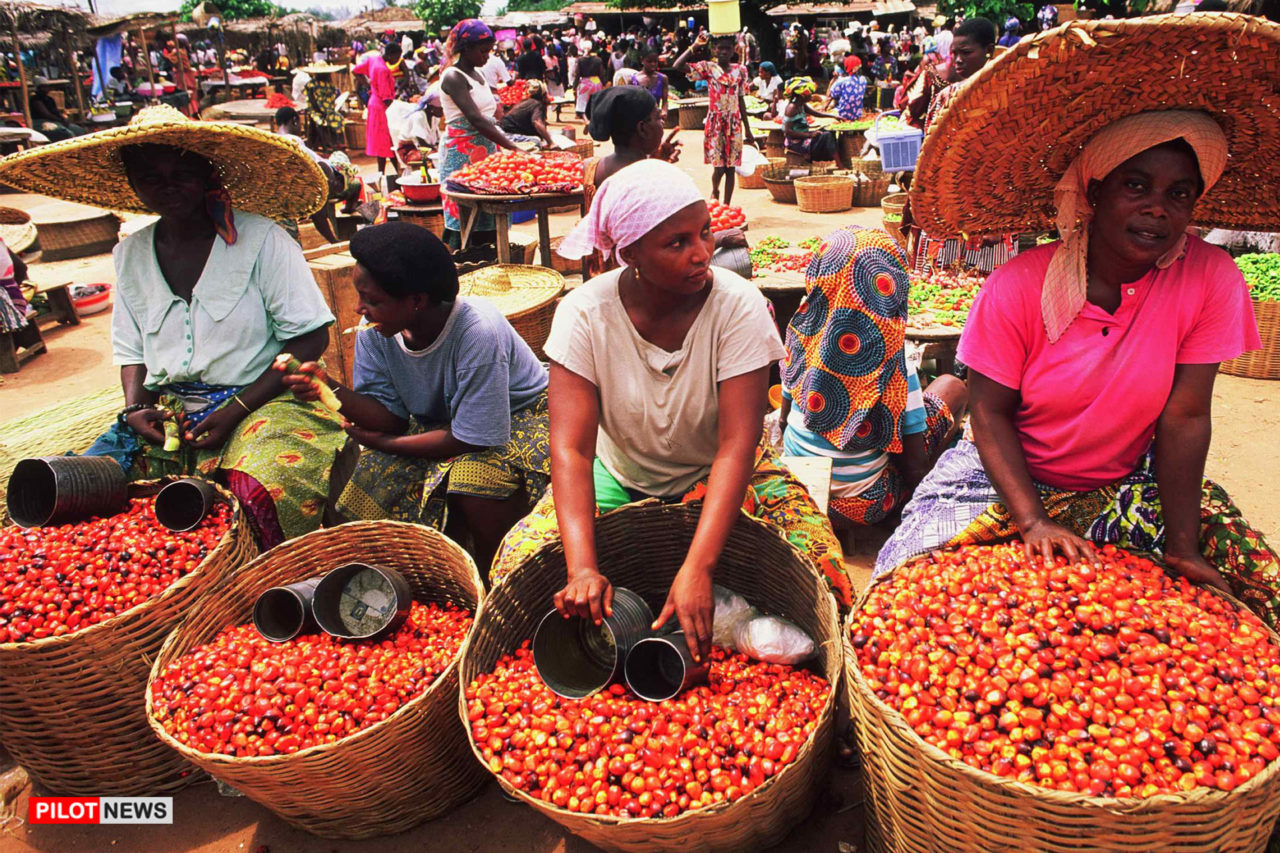
The NBS attributed the moderation largely to changes in the average prices of commodities, including palm oil, carrots, pepper, onions, cassava flour, beef, yam flour, water yam, melon (egusi), fresh ginger, fresh fish, Irish potatoes, wheat grain, frozen chicken, and turkey meat.
Despite the improvement, food and non-alcoholic beverages remained the largest contributor to overall inflation, accounting for 6.16 percentage points. Restaurants and accommodation services contributed 1.99 points, while transport accounted for 1.64 points.
Wide disparity across states
The latest figures also showed significant differences in inflationary pressure across the country.
Lagos recorded the highest year-on-year headline inflation at 23.68 per cent, followed by Zamfara at 22.56 per cent and Enugu at 22.06 per cent.
Sokoto recorded the lowest headline inflation at 2.11 per cent, followed by Kebbi at 3.72 per cent and Jigawa at 3.81 per cent.
For food inflation, Adamawa recorded the highest year-on-year rate at 38.85 per cent, followed by Zamfara at 37.96 per cent and Bayelsa at 36.20 per cent.
Borno recorded a negative food inflation rate of -4.04 per cent, followed by Jigawa at -0.23 per cent and Kebbi at 3.47 per cent.
On a month-on-month basis, food inflation was highest in Katsina at 9.48 per cent, followed by Rivers at 8.86 per cent and Osun at 8.32 per cent.
Taraba recorded the sharpest decline at -12.42 per cent, followed by Borno at -12.15 per cent and Bauchi at -8.88 per cent.
The NBS also reported that urban inflation stood at 15.88 per cent year-on-year in August, while rural inflation was lower at 14.23 per cent. However, prices rose faster month-on-month in rural areas, where inflation increased to 1.79 per cent, compared with 0.28 per cent in urban areas.
The latest figures suggest that the pace of price increases is continuing to moderate, although the relatively high food inflation rate means many households may still feel considerable pressure on their purchasing power.
The NBS also cautioned against making direct comparisons of consumption baskets across states because the weights assigned to food and non-food items vary with consumption patterns in each state.

- Wike Says Rainbow Coalition is for Tinubu, Not APC Candidates - September 15, 2026
- Inflation Slips to 15.39% as Food Price Pressure Eases in August - September 15, 2026
- Igbo Group Protests First Lady’s Chieftaincy Ceremony, - September 15, 2026