

…Says Education is a National Emergency
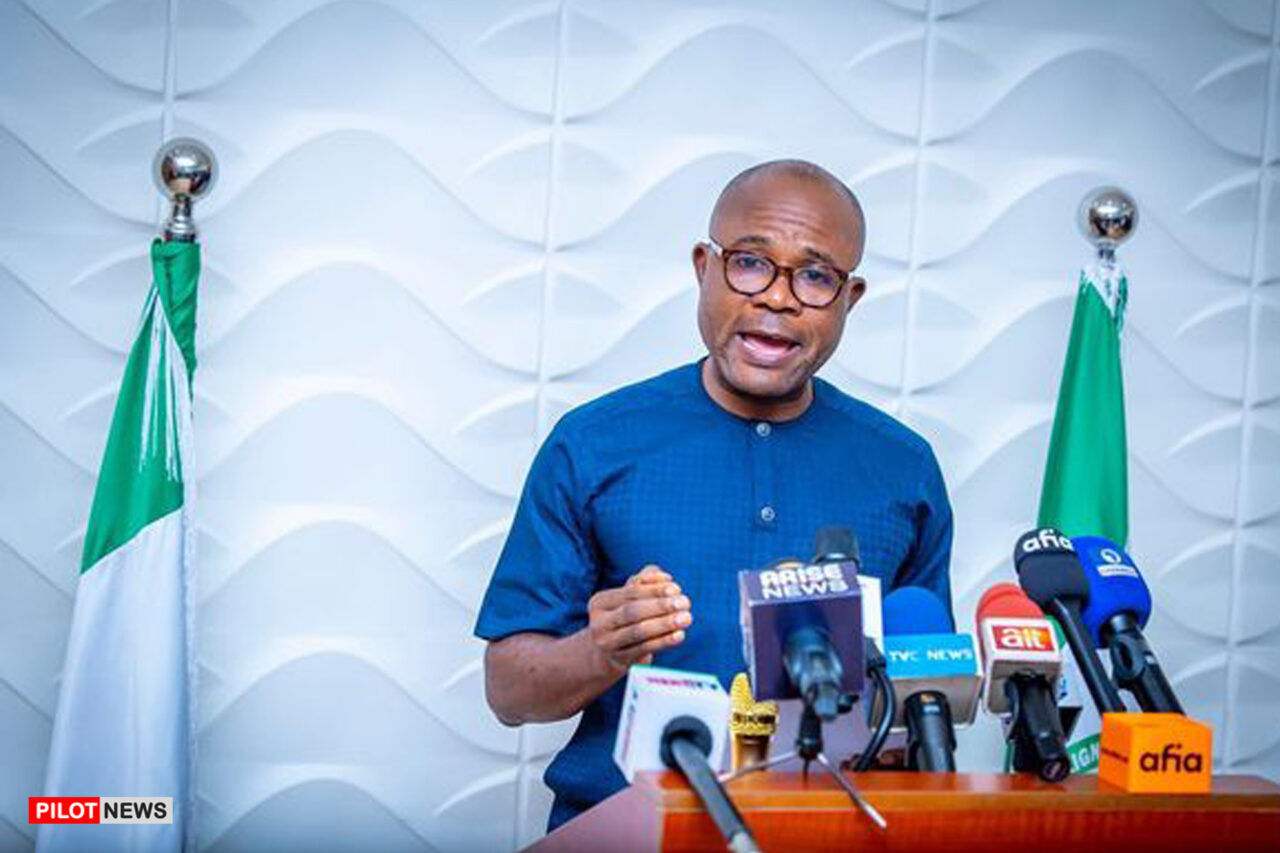
The Enugu State Governor Dr. Peter Ndubuisi Mbah at the launch of the state’s Education Policy posits that cost of education today far outweighs long-term liabilities of knowledge deficits hence the need for the state and the Federal Government to intentionally fund a quantum leap in the education sector.
Dr. Mbah made this declaration on Wednesday at the 2026 Enugu Education Summit and the unveiling of the Enugu Education Policy at the International Conference Centre, Enugu.
Rendering his key note address at the summit, themed, ‘Transforming Education for the Future: Leadership, Innovation, Partnership, Financing and Sustainable Reform,’ Gov. Mbah Nigeria is at a point where education must be treated as a national emergency.
“I believe Nigeria has reached the point where we must treat education as a national emergency. Not rhetorically, but in our budgets, our teacher development, our infrastructure, the standards we demand, and the partnerships we build between the Federal Government, states, development agencies, communities and the private sector.”
“Our future prosperity depends upon the knowledge and capabilities of our people, after all. And that means every Nigerian child, wherever they are born, must have access to an education capable of preparing them for the world they are entering.”
“Whatever education costs us today, ignorance will cost us far more tomorrow. Once we understand that, the question changes. It is no longer: Can we afford to make or fund this quantum leap? It becomes: What will happen to us if we do not?” he posits.
Reiterating the place of education in development and sustainability, Mbah argued that addressing the root causes of poverty and under development is vital.
“If we fix the road today but fail to educate the child who will maintain it tomorrow, how sustainable was our investment in the road?”
“If we build factories but lack the skilled people capable of running increasingly sophisticated production systems, where is our own Industrial Revolution going to come from?”
“And if millions of young people reach adulthood without the knowledge and capabilities to participate meaningfully in the economy, what exactly do we imagine the social cost of that will be?”
“So, if Nigeria is to become a creation economy rather than a consumption economy, then we must equip our young people not simply to use what the world creates, but to research, design, engineer and create what the world needs.”
“The point here is straightforward: transformation cannot survive on aspiration alone. Eventually, somebody has to pay for it,” the Enugu State Governor stated.
Citing his administration’s decision to invest 33 per cent of the state’s annual budget in education for three consecutive years, building 268 Smart Green Schools and equipping more than 7,000 classrooms with 21st-century learning tools, Mbah advocates for more funding for education sector in states and the nation.
“If Enugu’s experience offers one lesson, it is that when the scale of the challenge demands a quantum leap, audacity is not a luxury. It is a necessity. When we came into government, we had to look at that reality very closely. We could have repaired the existing system. We could have renovated some classrooms, supplied some desks, put computers into a few schools and called it reform.”
“But we had to ask ourselves a more difficult question: would it be enough? Would an education system essentially designed for the world of 40 years ago prepare an Enugu child for the world of 20 years from now? Our answer was ‘No’.”
“What we have attempted in Enugu is, therefore, not a collection of education projects. It is a change in the entire development model – a quantum leap,” he explained.
Unveiling the Enugu State Education Policy, Mbah revealed that the policy is applied now in the state and will serve as the benchmark for the state’s education sector over the next six to 10 years.
Meanwhile, the United Nations Children’s Fund (UNICEF), United Nations Educational, Scientific and Cultural Organization (UNESCO), British Council, and other global and national education stakeholders hails the governor for making education the centerpiece of his administration’s development agenda.
Speaking at the launch, the United Nations Children’s Fund, UNICEF, Chief of Field Office, Enugu, Mrs. Juliet Chilewe, commends Enugu State for demonstrating a strong commitment to UNICEF’s vision of education transformation through investments in Smart Green Schools, teachers, foundational learning, digital literacy and experiential learning.
“UNICEF is proud to have supported the development of the Enugu State Education Sector Plan 2026–2035,” she said.
The British Council, represented by the Director on English and School Education, Nigeria, Fwanshihsak Daniel, commends Peter Mbah Administration’s achievements in the education sector saying, “We commend Enugu State’s bold ambitions of an education system in which every learner develops strong foundations, creativity and the necessary skills to the society and the economy.”
The Commissioner for Education, Enugu State, Prof. Ndubueze Mbah, further assures stakeholders that Enugu State has begun a journey of irreversible educational progress.
The high point of the event was the official unveiling of the Enugu State Education Policy and a tour of the exhibition of the Smart Green School Innovation Studio, set up by students of the Smart Green Schools.

- GovernorPeterMbahLaunches Enugu Education Policy - October 8, 2026
- Enugu Police arrests suspects for vandalizing public infrastructure - October 7, 2026
- Guild Of Editors Commend Enugu Governor, Calls Leaders To Emulate Him - October 2, 2026