

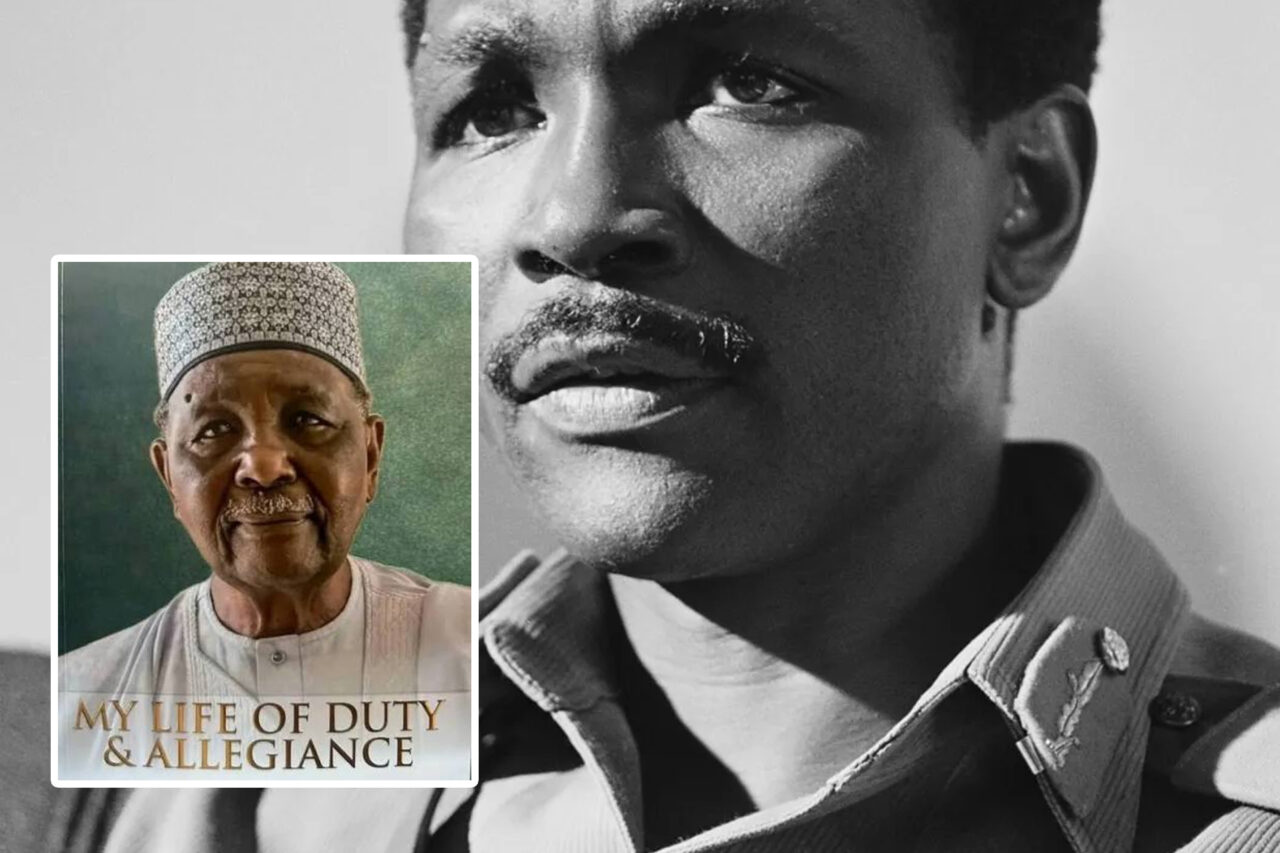
- Book Title: My Life of Duty and Allegiance
- Author: Yakubu Gowon
- Publishers: Continuity Books.
- Reviewer: Dr Emeaba O. Emeaba
- Pages: 881
When a military ruler who presided over a nation’s most catastrophic civil war waits until his tenth decade to publish his memoirs, the reader expects either a profound exercise in grand self-justification or an unburdening of the conscience. In My Life of Duty and Allegiance, General Yakubu Gowon—who assumed power in Nigeria in 1966 at the astonishingly raw age of 31—attempts to give us both. What emerges across 881 densely packed pages is a deeply complex, often moving, yet fundamentally contradictory document: the work of an elder statesman striving to polish his historical legacy, even as his own words repeatedly fracture the varnish.

Gowon’s narrative arc follows a classic post-independence path. Raised in Daura and Wusasa by Christian missionary parents, he traces his early life with an endearing warmth, detailing his rapid ascent through Sandhurst and the Royal Military Academy into the elite officer corps of a newly independent Nigeria. But the heart of the volume, inevitably, is the thirty-month Nigerian Civil War (1967–1970), born of the widespread anti-Igbo pogroms that drove a traumatized populace back to the Eastern Region, where secession was declared not out of mere political ambition, but as a desperate, last-stand effort to protect a people facing systemic annihilation—and the turbulent decade of military rule that surrounded it.
To his credit, Gowon writes with an understated dignity that sets his work apart from the bombastic memoirs typical of West Africa’s mid-century military junta leaders. He paints himself not as a tyrant, but as a reluctant servant of statehood—a devout Christian officer forced by tragedy and duty to hold a fracturing federation together at all costs. His reflections on the post-war reconciliation era, anchored by his famous post-conflict decree of “No victor, no vanquished,” radiate a genuine desire to present himself as a noble unifier.
Yet, for all its graceful prose and pious framing, the memoir’s historical value lies less in what it succeeds in proving than in where it visibly falters under critical scrutiny. For historians and careful readers alike, My Life of Duty and Allegiance contains profound textual and factual fractures—moments where the author’s defensive manoeuvring unwittingly conflicts with established records and even his own narrative logic.
Consider Gowon’s account of the chaotic July 29, 1966 counter-coup that brought him to power. Seeking to distance himself from the brutal assassination of his predecessor, General Aguiyi-Ironsi, Gowon writes of an impulsive attempt to save the Supreme Commander by phoning the Ikeja airport to order a rescue helicopter under “Major Paul Dickson.” It is a dramatic, noble story—except that military archives establish there was no officer by that name in the armed forces; the only Paul Dickson present was an Air Force staff sergeant tasked with sentry duty. More damaging still is the author’s silence regarding documented transcripts from that very afternoon, in which he authorized the arrest of Ironsi by rebellious officers, famously pausing before asking, “Can you do it?”
This habit of offering personal alibis in place of historical accountability recurs at key junctures. Addressing the collapse of the crucial January 1967 Aburi Accord in Ghana—the peace agreement that represented the last diplomatic exit ramp before full-scale war—Gowon attributes his acquiescence to a “shivering fever,” claiming he was too ill upon returning to Lagos to make sound decisions. Yet audio recordings of the conference reveal a lucid, composed negotiator. The subsequent dismantling of the accord via Decree No. 8 was not the by-product of malaria, but a calculated political retreat orchestrated under heavy pressure from senior federal bureaucrats and military advisers who feared a loss of centralized revenue and power.
Perhaps most unsettling is the book’s arithmetic of tragedy. In describing the devastating human toll of the civil war—where federal blockades and famine devastated the civilian population—Gowon routinely reduces the casualties to “thousands who perished.” To reduce a conflict in which an estimated one to two million Biafran non-combatants died of starvation and military action to a mere “thousand” is not simply an exercise in semantic gobbledygook; it is an attempt to rewrite the scale of a national catastrophe.
When the text turns to post-war governance, the contradictions deepen. Gowon presents his fiscal policies and the post-war “Three Rs” (Reconstruction, Rehabilitation, and Reconciliation) as gestures of generous magnanimity. Yet he glosses over the brutal reality of the federal policy that awarded a flat sum of just £20 to returning Easterners regardless of their prior bank balances, alongside the controversial Abandoned Properties Act. To reconcile such economic penalization with the high-minded rhetoric of “No victor, no vanquished” requires a degree of cognitive dissonance that the memoir simply cannot sustain.
Similarly, Gowon defends his 1974 decision to indefinitely postpone the transition to civilian rule—a betrayal of his own promises that directly prompted his overthrow in 1975—by citing the political unreadiness of the nation. It is the classic, self-serving paradox of the military autocrat: claiming the nation is too fragile for democracy after nearly a decade of absolute military control without constructing the very institutions necessary to support it.
The performative nature of the memoir’s publication was further underscored at its public launch in Abuja, where General Theophilus Danjuma—the key officer behind the July 1966 operation against Ironsi that vaulted Gowon to supreme power—served as the event’s primary benefactor, donating a staggering ₦3 billion to the project. For critics, the spectacle was less an act of literary patronage than a symbolic closing of ranks among the war’s chief beneficiaries. That a former career officer whose vast post-military fortune stems not from industrial enterprise, manufacturing, or commercial risk, but from lucrative state-awarded discretionary oil concessions, could single-handedly underwrite the celebration of the regime’s official story speaks volumes. It highlights a troubling continuation of the “spoils of war”—a political economy where the wealth and historical narrative of the state remain firmly concentrated in the hands of the very men who reshaped it by force.
My Life of Duty and Allegiance remains an indispensable primary source. It offers an intimate, highly readable window into the mind of a leader who stood at the absolute epicentre of modern Africa’s most traumatic conflict. But readers seeking a candid historical accounting will be disappointed. General Gowon has given us an evidence of faith, duty, and deliberate selective memory. In trying so painstakingly to defend his record, the aging commander has inadvertently provided the very evidence that destabilizes his official history.
_________
♦ Dr. Emeaba, the author of “A Dictionary of Literature,” writes dime novels in the style of the Onitsha Market Literature sub-genre.

- ‘My Life of Duty and Allegiance’ —An Elder Statesman’s Version of the Truth - November 8, 2026
- Can Nigerian Voters Replicate America’s Midterm Electoral Revolt? - November 8, 2026
- Beyond ‘Emi Lokan’: Why Performance Should Decide Nigeria’s Next President - November 8, 2026