

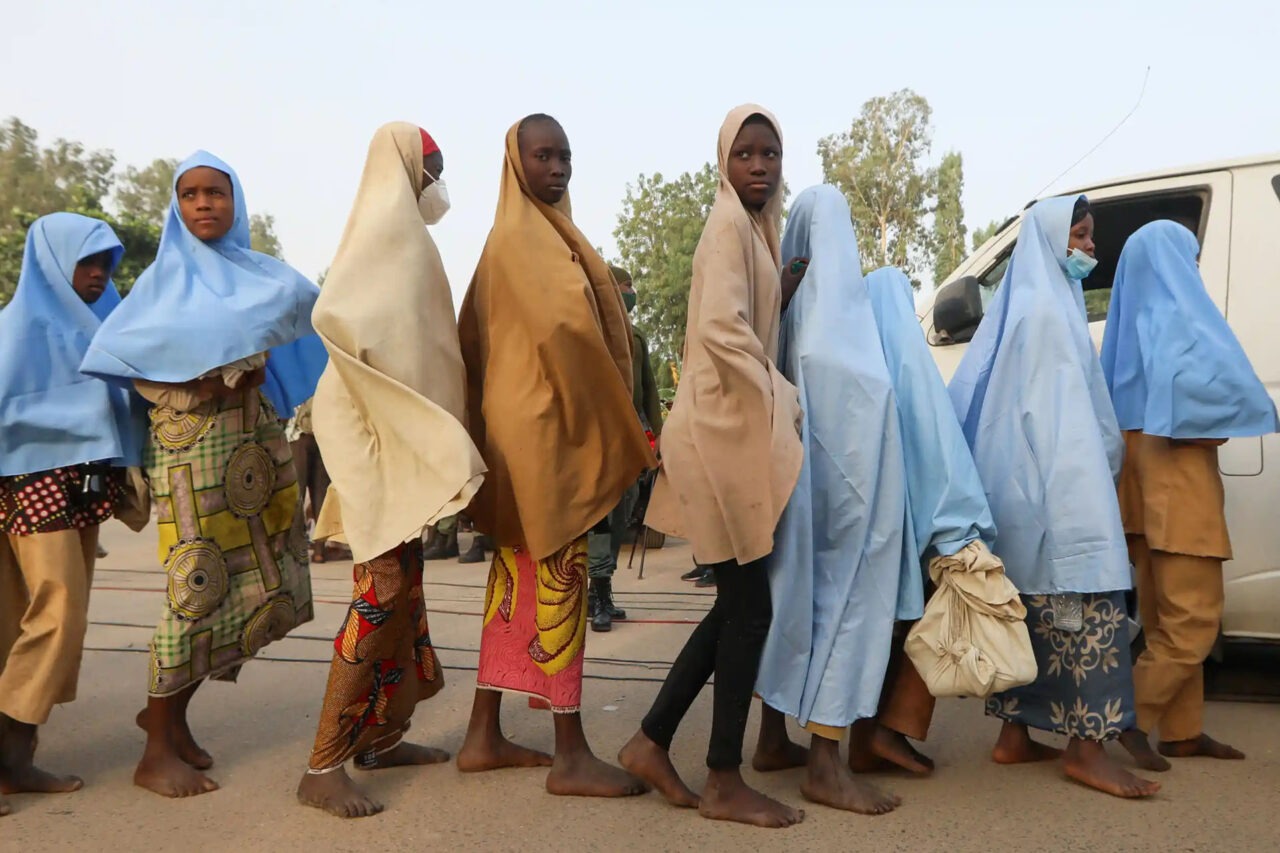
When 276 schoolgirls were snatched from Government Girls’ Secondary School, Chibok, Borno State, on 14 April 2014, the attention of the international community zeroed in on Nigeria.
Almost immediately, the Nigerian government, alongside global and local partners, launched the Safe School Initiative (SSI) to stop such horrific attacks. Ten years later, the nightmare has not ended.
Two School Attacks in One Week
In just one week in November, over 300 pupils were abducted from two schools in northern Nigeria.
On the morning of 17 November, gunmen stormed Government Girls Comprehensive Secondary School in Maga, a town in northwestern Kebbi State, killing the vice-principal and abducting 25 girls.

Before parents and authorities could catch their breath, another tragedy struck.
On 21 November, another group of terrorists attacked St. Mary’s Catholic School, Papiri in Niger State, kidnapping 303 pupils and 12 teachers.
In response, five northern states—Kwara, Plateau, Niger, Benue, and Katsina—shut down public schools indefinitely as a precautionary security measure.
While some of the abducted children have since regained freedom, the back-to-back school raids have again exposed one of Nigeria’s most persistent security failures.
The attacks have also reignited the burning question: Where is the much-touted protection promised by the Safe Schools Initiative (SSI)?
The ‘Safe Schools’ Project
The SSI was launched in April 2014, shortly after the Chibok abduction, by the UN Special Envoy for Global Education, Gordon Brown, alongside the Nigerian Global Business Coalition for Education and private-sector leaders at the World Economic Forum Africa.
The initiative has three broad goals: to transfer students from high-risk communities to safer educational zones; to reconstruct and fortify school infrastructure, including perimeter fencing and security management plans; and to provide innovative learning support for children in IDP camps.
SSI began with US$10 million in seed funding, which expanded to over US$30 million between 2014 and 2021.
In 2022, the Federal Government committed an additional ₦144.8 billion under a four-year financing plan for the period 2023 to 2026. According to the plan, the funding for the years as follows: ₦32.58 billion for 2023, ₦36.98 billion for 2024, ₦37.15 billion for 2025, and ₦38.03 billion for 2026.
In 2023, a ₦15 billion take-off grant was released as part of the 2023 allocation, with the remainder expected to come from state governments, the private sector, and development partners.
Yet results remain discouraging. Out of over 170,000 schools in Nigeria, only 11,550 (less than seven percent) are registered under the National Safe Schools Response and Coordination Centre.
Many states have not funded their share of the Initiative or equipped the necessary offices to enable operations.
Timeline of School Kidnappings
Despite the SSI, mass school kidnappings have become regular.
Since 2014, over 1,400 schoolchildren have been abducted in northern Nigeria. After the Chibok incident, Nigeria has witnessed several other school abductions.
2018: 110 schoolgirls abducted in Dapchi, Yobe State on 19 February.
2020: 303 schoolboys were abducted in Kankara, Katsina State, on 11 December, and 80 children were taken from an Islamic school in Katsina on 19 December.
2021: 41 pupils abducted in Kagara, Niger State on 17 February; 317 girls kidnapped in Jangebe, Zamfara State on 26 February; 39 students taken from the College of Forestry, Afaka, Kaduna State on 11 March; 20 students kidnapped at Greenfield University, Kaduna on 20 April; at least 150 pupils abducted from Salihu Tanko Islamiyya School, Tegina, Niger State on 30 May; 96 students abducted at Government College, Birnin Yauri, Kebbi State on 17 June; and 121 students abducted from Bethel Baptist High School, Kaduna on 5 July.
2024: 287 pupils abducted from LEA Primary and Secondary School, Kuriga, Kaduna, on 7 March; and 15 pupils seized in Gidan Bakuso, Sokoto State, on 9 March.
And the recent attacks in Kebbi and Niger States in November 2025.
Kidnapping of schoolchildren in Nigeria began with Boko Haram, whose name translates to ‘Western education is forbidden’. But the tactic has since been adopted by criminal gangs called ‘bandits’, who have no ideological motives beyond ransom payments.
The recurring attacks have intensified concerns that the SSI has failed to live up to its expectations.
Where Did the Safe School Funds Go?
The Senate has launched an investigation into the SSI, expressing outrage that despite a decade of heavy funding, high-level commitments and donor support, schools remain exposed to attacks and mass abductions.
Senator Orji Uzor Kalu, chairman of the ad-hoc investigative committee, described the situation as “unacceptable for a nation committed to educational development and child safety.”
He said the committee would conduct a comprehensive operational and financial audit involving federal ministries, state governments, security agencies and civil society actors to trace how funds released since 2014 were spent.
“It is unacceptable that our schools remain soft targets for terrorists and kidnappers,” Kalu said. “We will track every naira and every dollar allocated to the Safe School Initiative. Nigerians deserve to know why, despite enormous investment and global support, our schools remain unsafe.”
The review will cover the utilisation of federal and donor funds, the deployment and effectiveness of security personnel, early warning and emergency response systems, and infrastructural upgrades in high-risk schools.
The Senator emphasised that the probe was not intended to victimise any official, but to restore credibility to an initiative that has suffered a collapse of public confidence.
“This is not a witch-hunt. We owe it to Nigerian parents to ensure that their children can pursue education without fear. We will not rest until we get answers,” he added.

- Federal Government Sets Six Weeks to Review Tax Laws - September 18, 2026
- State Police Bill Moves to 36 State Assemblies for Approval - September 18, 2026
- Church of Nigeria Announces Hostsof 2027–2028 Standing Committee Meetings - September 18, 2026