

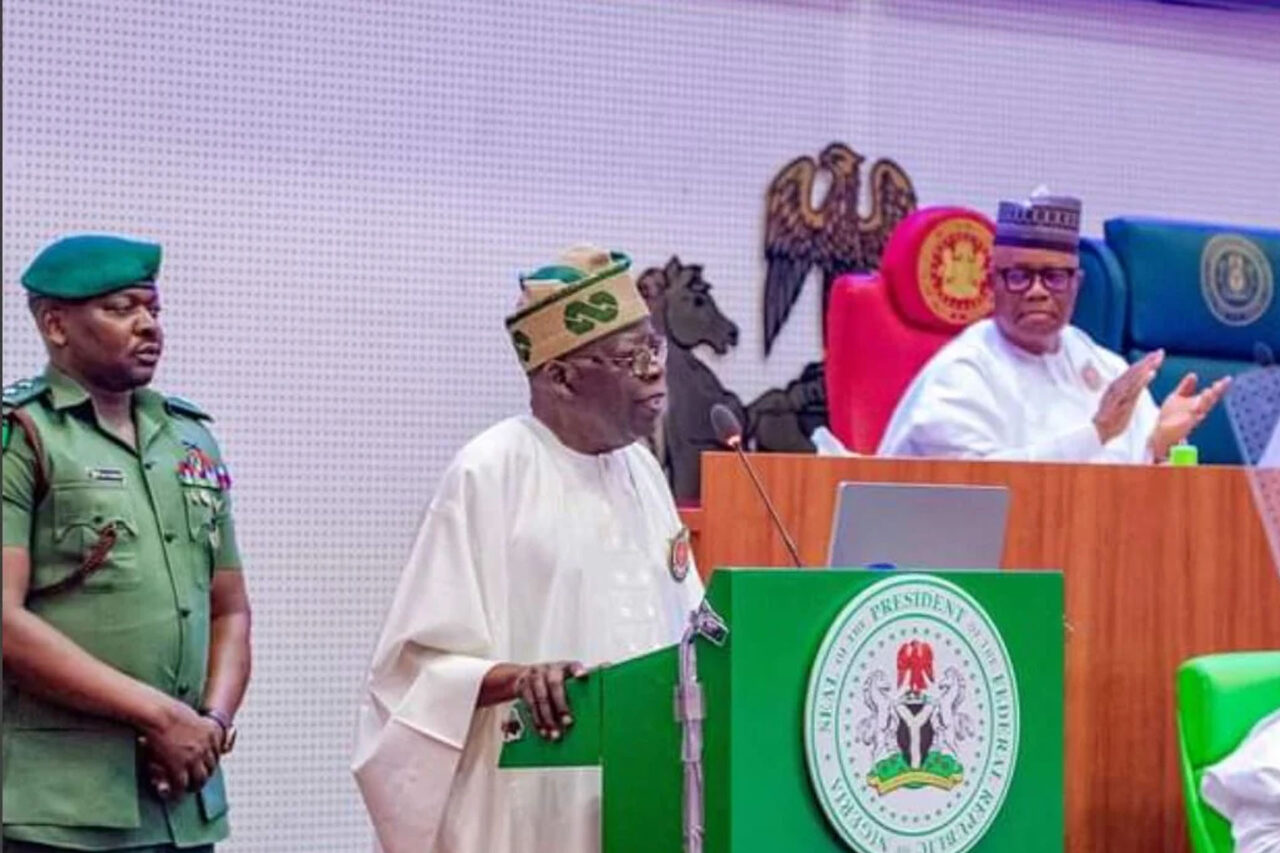
… Says New Tax Laws Will Broaden Base, Boost Non-Oil Revenues – Abbas
President Bola Ahmed Tinubu on Friday presented before a joint sitting of the National Assembly the 2026 Appropriation Bill, which he described as a “Budget of Consolidation, Renewed Resilience and Shared Prosperity.” The proposal estimates total revenue at ₦34.33 trillion, while total expenditure is put at ₦58.18 trillion, including ₦15.52 trillion earmarked for debt servicing. Capital spending is projected at ₦26.08 trillion, with a fiscal deficit of ₦23.85 trillion, equivalent to 4.28 per cent of Gross Domestic Product (GDP).
While presenting the budget, Tinubu told lawmakers that the 2026 fiscal plan marks a critical phase in Nigeria’s ongoing economic reforms and transformation agenda. He said that over the past two and a half years, his administration had taken deliberate steps to address deep-rooted structural challenges, stabilise the economy, restore investor confidence, and lay the groundwork for a more inclusive and resilient nation.
The President acknowledged the difficulties Nigerians have endured during the reform process but assured citizens that the sacrifices would yield lasting benefits. According to him, although reforms often come with short-term pains, they remain the most reliable path to long-term stability and shared prosperity.
Tinubu cited improvements in key macroeconomic indicators as evidence that the reform measures are yielding results. He noted that the economy recorded a growth rate of 3.98% in the third quarter of 2025, compared to 3.86% in the corresponding period of 2024. Inflation, he added, has eased for eight consecutive months, falling to 14.45 per cent in November 2025, while oil output, non-oil revenue performance, and external reserves have all improved significantly.
“These results didn’t occur by chance; they are the product of tough and sometimes unpopular policy decisions,” the President said, stressing that the 2026 budget is designed to lock in existing gains, enhance economic resilience, and move the country from economic recovery to sustained growth.
He explained that the budget is built around four key pillars: strengthening macroeconomic stability, improving the investment and business climate, driving job-rich economic growth, and deepening human capital development while safeguarding the most vulnerable segments of society. To this end, priority sectors such as security, education, health, and infrastructure received substantial allocations. Defence and security were allocated ₦5.41 trillion, infrastructure ₦3.56 trillion, education ₦3.52 trillion, and healthcare ₦2.48 trillion.
On the security front, Tinubu announced the adoption of a new national counterterrorism doctrine aimed at tackling banditry, militias, armed criminal groups, violent cults, and foreign-linked mercenaries. He also disclosed that funding for education and health would be strengthened through the Nigerian Education Loan Fund and a statutory allocation of six per cent of the budget net of liabilities, with support from international partners, including the United States.
The President said government investment in infrastructure and productivity-enhancing sectors would focus on transportation networks, energy supply, port modernisation, and agricultural reforms targeted at boosting food security and employment. He highlighted plans for mechanised agriculture across seven regional hubs, covering one million hectares, with the dual objective of job creation and increased export earnings.
Tinubu further underscored the importance of procurement reforms and the implementation of the “Nigeria First Policy” as part of efforts to promote local content, strengthen domestic industries, and achieve sustainable economic self-reliance.
“Distinguished Members, the true value of a budget lies not in its announcement, but in its execution,” the President said, pledging improved revenue generation, prudent expenditure management, and enhanced accountability in budget implementation.
Reacting to the budget presentation, Speaker of the House of Representatives, Rt. Hon. Tajudeen Abbas, emphasised the role of newly enacted tax laws in broadening the revenue base, promoting fairness, and strengthening non-oil revenue streams. He said the reforms provide a solid and sustainable financing framework for the 2026 Appropriation Bill.
Abbas commended the President’s commitment to a unified fiscal framework, describing the “one budget, one fiscal framework” policy and the elimination of overlapping fiscal authorities as crucial steps toward greater discipline, transparency, and adherence to due process. He assured Nigerians that the National Assembly would subject the budget proposal to rigorous scrutiny while acting with speed, diligence, and patriotism to ensure optimal value for public funds.
On security spending, the Speaker noted that adequately funded and transparently managed security expenditure is fundamental to national development. He reaffirmed the legislature’s resolve to ensure that security allocations translate into visible and measurable improvements across the country.
Reflecting on the previous fiscal year, Abbas described 2025 as a period of adjustment and consolidation, pointing to improvements in foreign exchange reserves, remittance inflows, and export earnings as indicators of renewed confidence in the Nigerian economy.
He expressed gratitude to President Tinubu, the Senate President, and members of both chambers of the National Assembly for their leadership and commitment to national service, assuring Nigerians that the legislature would work closely with the executive to ensure effective implementation of the 2026 budget. According to him, the Appropriation Bill signals a return to fiscal discipline, strengthened confidence, and a firmer foundation for inclusive growth and long-term national development.

- NAF Plane Crash: PDP Condoles With NAF, Families Of Victims - October 5, 2026
- Reps Probe NOUN Law Graduates’ Exclusion From Nigerian Law School - October 3, 2026
- Oyebanji Assures Commitment To Inclusive Governance - October 3, 2026