
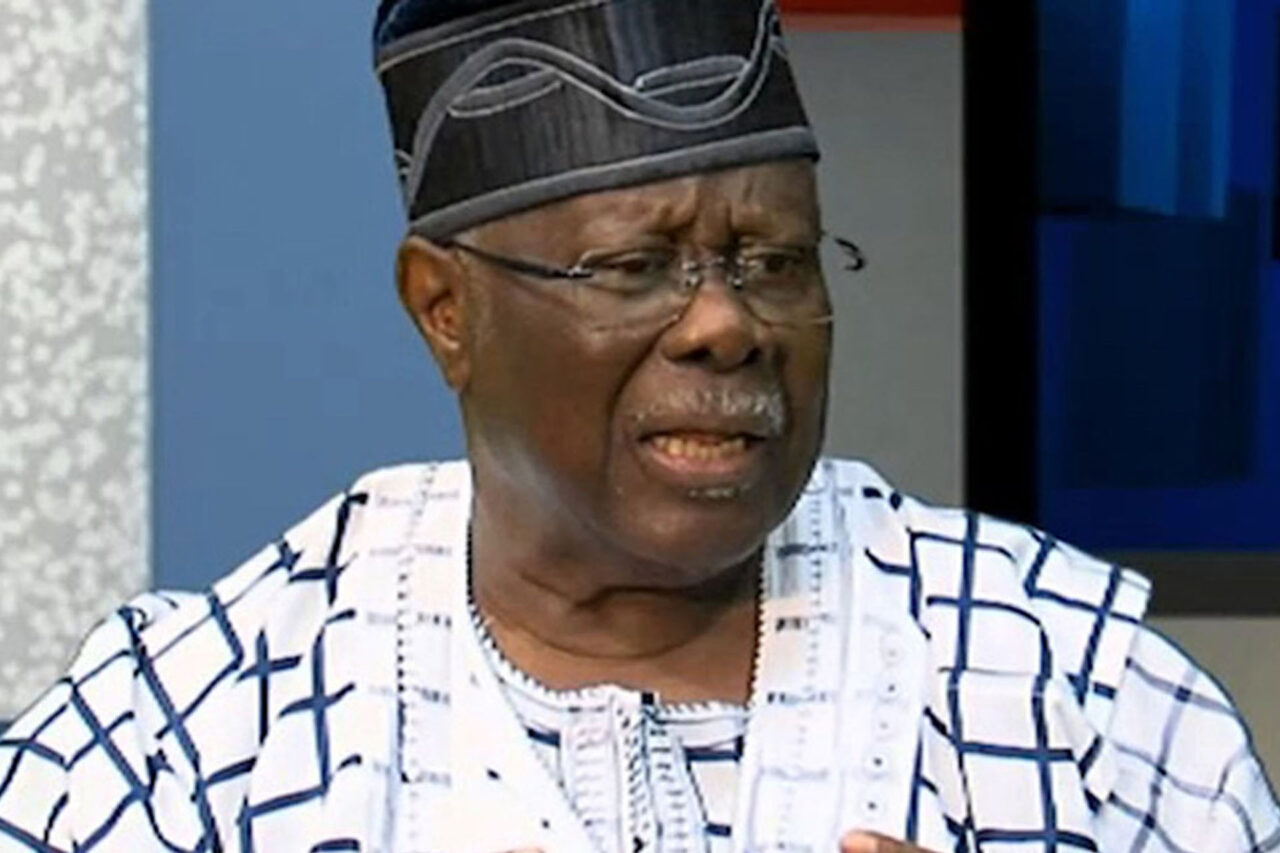
Former Deputy National Chairman of the Peoples Democratic Party (PDP), Chief Olabode George, has condemned the use of the judiciary to suppress opposition.
He also expressed concern that Nigeria democracy is under siege, faults what he described as a calculated attempt to undermine Nigeria’s democracy through the misuse of state institutions and judicial processes.
The Atona Oodua of Yourubaland, in a statement on Tuesday, urged the judiciary to remain faithful to the Constitution, and charged the Independent National Electoral Commission (INEC) to discharge its constitutional responsibilities without fear or favor.
He also appealed to President Bola Ahmed Tinubu to ensure that every institution of government remains above partisan interests.
George was reacting to the Court of Appeal’s judgment in Abuja, which upheld an order restraining INEC from recognizing the state congresses held by committees constituted by the David Mark-led caretaker leadership of the African Democratic Congress (ADC).
According to the elder statesman, the recent developments point to a dangerous pattern of political interference aimed at weakening opposition parties ahead of the 2027 general elections.
“What’s unfolding before our eyes is nothing short of an assault on constitutional democracy. There appears to be a deliberate attempt to weaponise institutions of state against opposition political parties because some people are afraid of allowing Nigerians to freely choose their leaders.
“That’s not democracy. That’s political intimidation.”
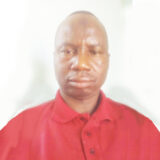
George described Abdulrahman Mohammed, the chairman of the Nyesom Wike-backed faction of the PDP, as someone who lacks the democratic pedigree and political experience required to lead a party of the PDP’s stature.
“Let me be absolutely clear. There’s nothing dishonorable about being a driver. Honest labour deserves dignity and respect.
“However, nobody becomes the National Chairman of one of Africa’s largest political parties by executive fiat or political manipulation.
“Leadership is earned through years of sacrifice, service, loyalty, commitment and democratic legitimacy.
“The issue is not that this man was once a driver. The issue is that someone with no known democratic pedigree, no recognized history of building the PDP, no record of leadership within its structures, and no visible contribution to the party’s growth is suddenly being projected as National Chairman.
“Who knows him in our democratic struggle? Where was he when this party was founded in 1998? What sacrifice has he made for the PDP? Leadership cannot be manufactured overnight simply because powerful interests have decided to impose someone on a political party.
“Every discerning Nigerian can see what is happening. This is not about promoting one individual. This is about infiltrating, destabilising and ultimately destroying the PDP from within. Those behind this agenda are attempting to use one man as a vehicle to weaken the opposition.”
George argued that both the judiciary and INEC must remain faithful to the Constitution and the settled principles of Nigerian law.
“The law on this issue has been settled for decades.
“As far back as Onuoha v. Okafor (1983) 2 SCNLR 244, the Supreme Court held that the internal affairs of political parties, including the choice of candidates, are generally political questions that ought not to be determined by the courts.
“That principle was reaffirmed in Dalhatu v. Turaki (2003) 15 NWLR (Pt. 843) 310, where the Supreme Court again emphasised that internal party matters belong primarily to political parties except where the Constitution or statute expressly provides otherwise.
“The same principle was echoed in Umeh v. Ejike (2013), where the Court of Appeal, relying on settled Supreme Court authorities, reaffirmed that the internal administration of political parties is generally not justiciable except where the law expressly confers jurisdiction.
“The message from our superior courts has been consistent for over forty years: political parties must be allowed to regulate their own internal affairs within the framework of their constitutions and the law.”
- Fintiri donates 15 Hilux vehicles, 300 motorcycles to traditional rulers - October 16, 2026
- NBA’s Project in Adamawa secures over 2,000 NIN cards to IDPs - October 16, 2026
- TikTok Content Creator Connects Northern and Southern Nigerians - October 15, 2026