

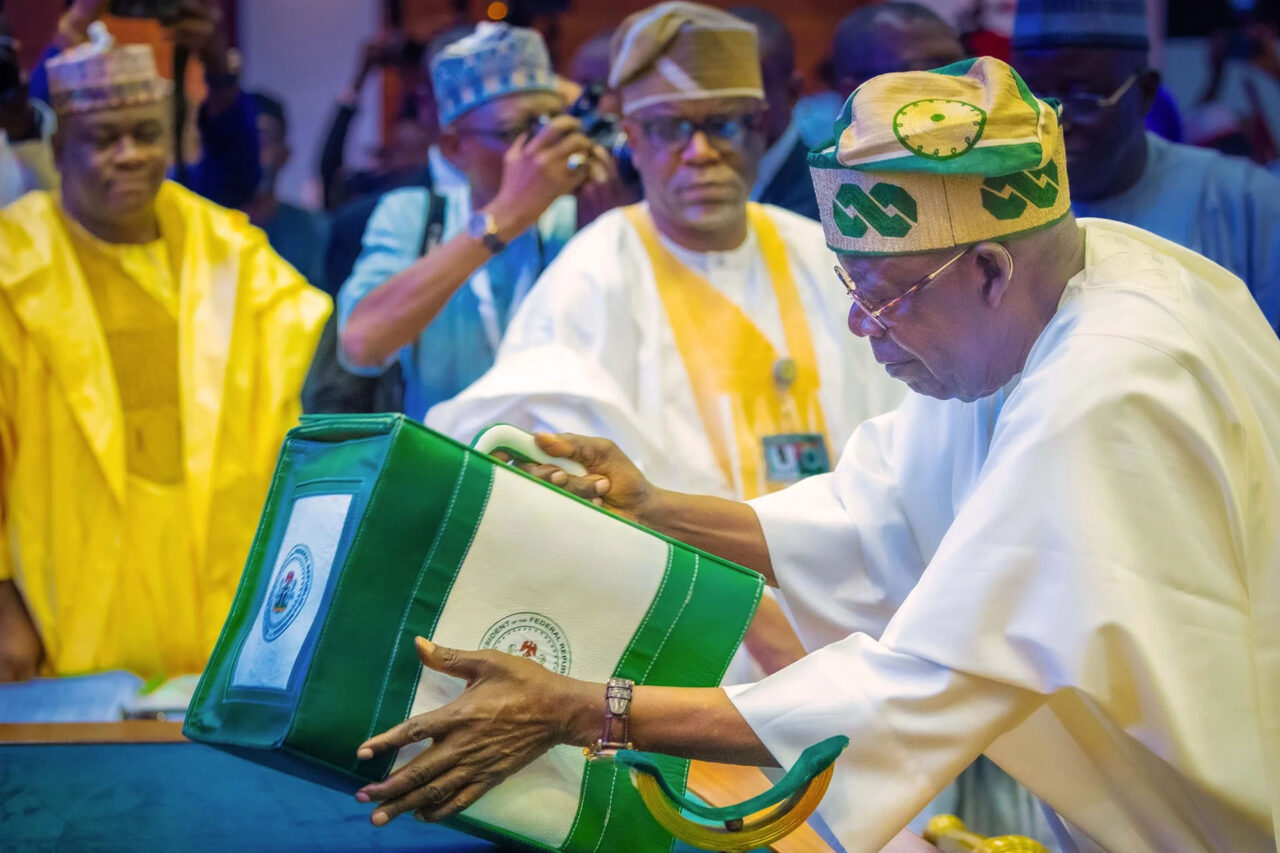
President Bola Ahmed Tinubu on Friday presented a ₦58.18 trillion 2026 Appropriation Bill to a joint session of the National Assembly, declaring that Nigeria had moved “from survival to growth” and was entering a phase of consolidation after two and a half years of painful economic reforms.
The budget, themed “Budget of Consolidation, Renewed Resilience and Shared Prosperity,” projects a deficit of ₦23.85 trillion, representing 4.28 per cent of GDP, with ₦15.52 trillion earmarked for debt servicing and ₦26.08 trillion for capital expenditure.
Tinubu said the proposal marked a turning point in Nigeria’s reform journey, arguing that recent sacrifices by citizens were beginning to yield results.
“Though necessary, the reforms have not been painless,” he said. “Families and businesses have faced pressure; established systems have been disrupted; and budget execution has been tested.”
However, he assured Nigerians that “their sacrifices are not in vain,” adding: “The path of reform is seldom smooth, but it is the surest route to lasting stability and shared prosperity.”
According to the President, the 2026 budget was designed to “take this country out of the dark tunnel of hopelessness, from survival to growth,” while maintaining macroeconomic stability and ensuring that economic expansion translates into job creation and improved living standards.
Tinubu informed lawmakers that key economic indicators had shown improvement, citing a GDP growth rate of 3.98 percent in the third quarter of 2025, up from 3.86 percent in the same period in 2024. He also stated that inflation had moderated for eight consecutive months, with headline inflation declining to 14.45% in November 2025 from 24.23% in March.
“With stabilising food and energy prices, tighter monetary conditions, and improving supply responses, we expect the deflationary trend to persist over the 2026 horizon, barring major supply shocks,” he said.
The President added that oil production had improved due to enhanced security and sector reforms, while non-oil revenues had expanded through better tax administration. He also disclosed that Nigeria’s external reserves had climbed to a seven-year high of about $47 billion, providing over 10 months of import cover.
“These outcomes are not accidental or lucky,” Tinubu said. “They are the consequence of our difficult policy choices. Our next objective is to deepen our gains in pursuit of enduring and inclusive prosperity.”
The 2026 budget projects total revenue of ₦34.33 trillion against total expenditure of ₦58.18 trillion. Recurrent non-debt expenditure is estimated at ₦15.25 trillion.
The fiscal framework is based on a crude oil benchmark of $64.85 per barrel, oil production of 1.84 million barrels per day, and an average exchange rate of ₦1,400 to the dollar.
“These numbers are not mere accounting lines,” Tinubu told the National Assembly. “They are a statement of national priorities.”
He pledged continued commitment to “fiscal sustainability, debt transparency, and value-for-money spending,” while promising to reduce waste and strengthen controls.
Acknowledging challenges in past budget implementation, the President stated that only 17.7 percent of the 2025 capital budget had been released as of the third quarter, largely due to the extension of the 2024 capital budget.
He declared that 2026 would be “a year of stronger discipline in budget execution,” revealing that he had issued directives to thr Honourable Minister of Finance and Coordinating Minister of the Economy, the Honourable Minister of Budget and Economic Planning, the Accountant‑General of the Federation, and the Director‑General of the Budget Office of the Federation to ensure strict adherence to appropriated timelines and details.
“We expect improved revenue performance through the new National Tax Acts and the ongoing reforms in the oil and gas sector — reforms designed not merely to raise revenue, but to drive transparency, efficiency, fairness, and long‑term value in our fiscal architecture,” he said.
President Tinubu also announced tougher measures for government-owned enterprises, warning that Nigeria could no longer tolerate inefficiencies. “Nigeria can no longer afford leakages, inefficiencies, or underperformance in strategic agencies,” he said. “Every institution must play its part.”
Security received the largest sectoral allocation, with ₦5.41 trillion proposed for defence and security. Tinubu said national security remained “the foundation of development” and promised a tougher stance against violent groups.
“We will show no mercy to those who commit or support acts of terrorism, banditry, kidnapping for ransom, and other violent crimes,” he declared.
The President announced a new national counterterrorism doctrine under which “any armed group or gun-wielding non-state actors operating outside state authority will be regarded as terrorists.”
“Bandits, militias, armed gangs, armed robbers, violent cults, forest-based armed groups and foreign-linked mercenaries will all be targeted,” he said. “We will go after all those who perpetrate violence for political or sectarian ends, along with those who finance and facilitate their evil schemes.”
Education is allocated ₦3.52 trillion, while health will receive ₦2.48 trillion, representing 6% of the total budget size net of liabilities. Tinubu stated that more than 788,000 students have benefited from the Nigerian Education Loan Fund, in partnership with 229 tertiary institutions.
In healthcare, he disclosed that engagements with the United States government had opened access to over $500 million for health interventions, pledging transparent deployment of the funds.
Infrastructure spending stands at ₦3.56 trillion, with a focus on transport, energy, ports and agriculture. Tinubu said food security would remain a national priority, with investments in mechanisation, irrigation, storage, and agro-value chains.
He also highlighted plans by the Bank of Agriculture to support the cultivation of one million hectares and create hundreds of thousands of jobs.
The President stressed that implementation would be key. “The most significant budget is not the one we announce. It is the one we deliver,” he said.
He outlined three commitments for 2026: improved revenue mobilisation, more focused spending on measurable projects, and enhanced accountability.
“The 2026 budget is not a budget of promises; it is a Budget of consolidation, renewed resilience and shared prosperity,” Tinubu said, “it is a Budget of consolidation, renewed resilience and shared prosperity. It builds on the reforms of the past two and a half years, addresses emerging challenges, and sets a clear path towards a more secure, more competitive, more equitable, and more hopeful Nigeria.”

- Tinubu Back in Nigeria After State Visit to UK - March 20, 2026
- Nigeria Opens Door to UK Deportees in New Migration Agreement - March 20, 2026
- PDP, ADC Knock Tinubu Over Nigeria’s Ranking in Global Terrorism Index 2026 - March 20, 2026