

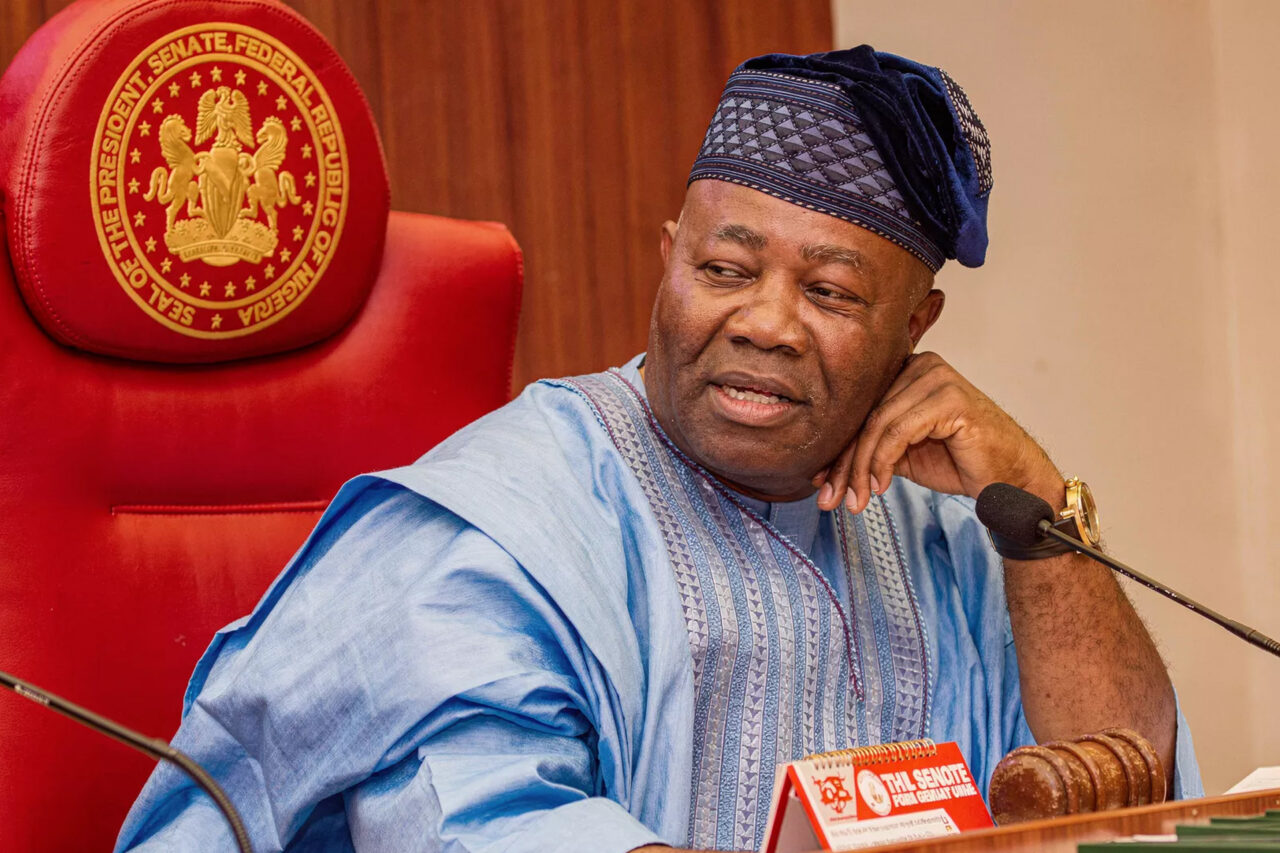
The Senate on Wednesday passed a constitutional amendment bill seeking to establish state police, marking a significant step towards restructuring the country’s policing architecture and addressing persistent security challenges.
The proposed legislation, transmitted to the National Assembly by President Bola Tinubu, was approved after lawmakers considered and adopted its 26 clauses during the Committee of the Whole.
If eventually ratified by at least two-thirds of the state Houses of Assembly and assented to by the President, the amendment will create a constitutional framework for state-controlled police services operating alongside a restructured Federal Police Service.
Leading debate on the bill, Senate Leader Opeyemi Bamidele described the proposal as one of the most consequential constitutional reforms since Nigeria’s return to democratic rule.
“This Bill represents one of the most significant constitutional reforms in our nation’s democratic evolution. It addresses a long-standing national conversation on the structure, effectiveness, responsiveness and sustainability of policing in the Federal Republic of Nigeria,” he said.
Bamidele argued that the country’s increasingly complex security environment had exposed the limitations of a centralized policing structure.
“The increasing complexity of security threats, which include terrorism, banditry, kidnapping, communal conflicts, farmer-herder clashes, cybercrime, organized criminal networks and other transnational crimes, has placed enormous pressure on the existing policing framework,” he said.
Under the proposed amendment, states would be empowered to establish their own police services through legislation passed by their Houses of Assembly, provided they meet minimum national standards prescribed by the National Assembly.
The Federal Police Service would retain responsibility for national security functions, including counter-terrorism, organized crime, cybercrime, border security, arms trafficking, and policing of the Federal Capital Territory.
The bill also grants the Federal Government emergency intervention powers in cases involving threats to national security, breakdown of public order, serious human rights abuses, or situations where a state police service becomes ineffective.
In such circumstances, the Federal Police Service may assume temporary operational control of a state police service, subject to presidential authorization, Senate oversight, and judicial review.
To address longstanding fears of political abuse, the legislation prohibits governors from directing state police authorities to target individuals, political parties, associations or groups. It also bars the use of police powers for partisan, ethnic, religious, sectional or personal purposes.
The proposed framework establishes State Police Service Commissions responsible for recruitment, promotion, discipline and oversight, while a reconstituted National Police Council would coordinate national policing policies and intergovernmental cooperation.
During the debate, Senator Enyinnaya Abaribe of Abia South disclosed that he had previously opposed state policing but had reconsidered his position because of the country’s worsening security situation.
“Mr. President, I used to be one of those that is against state police. Mark my words; I used to be,” Abaribe said.
“But today, we know that we have a very serious insecurity problem that can only be solved by thinking outside the box. And I think that this is part of it.”
However, the lawmaker expressed concerns about provisions that could allow the President to take over a state police service.
“We cannot have a situation where the president just looks at a state, maybe he’s not in good terms with the governor, and decides that he will take it over,” he said.
Abaribe also called for constitutional safeguards to guarantee direct funding for state police commissions and prevent political interference.
Senator Aminu Tambuwal of Sokoto South also threw his weight behind the proposal, describing it as a major step towards strengthening federalism.
“I am in support of this bill and I am in support of the idea of state police,” Tambuwal said. “I have been consistent on this… because I believe that that will also be a major leap into entrenchment of federalism in Nigeria.”
Citing recurring attacks in Sokoto State, Tambuwal argued that alternative approaches were needed to tackle insecurity nationwide.
“Every effort, any effort to curb this menace of insecurity in Nigeria is needed,” he said.
Presiding over the session, Senate President Godswill Akpabio described the bill as a historic legislative undertaking and urged lawmakers to place national interest above all other considerations.
The passage of the bill represents one of the most ambitious attempts to reform Nigeria’s security structure since the country’s return to civilian rule in 1999. However, the proposed amendment must still secure the approval of at least two-thirds of the 36 state legislatures before it can become law.

- Anambra Debt War: InterSociety Challenges Soludo’s $123.7m Claim Against Obi - September 25, 2026
- FG Cuts Interest on Late Tax Payments, Sets New Rate From October - September 25, 2026
- CBN Lowers Interest Rate to 23% as Inflation Eases - September 22, 2026