

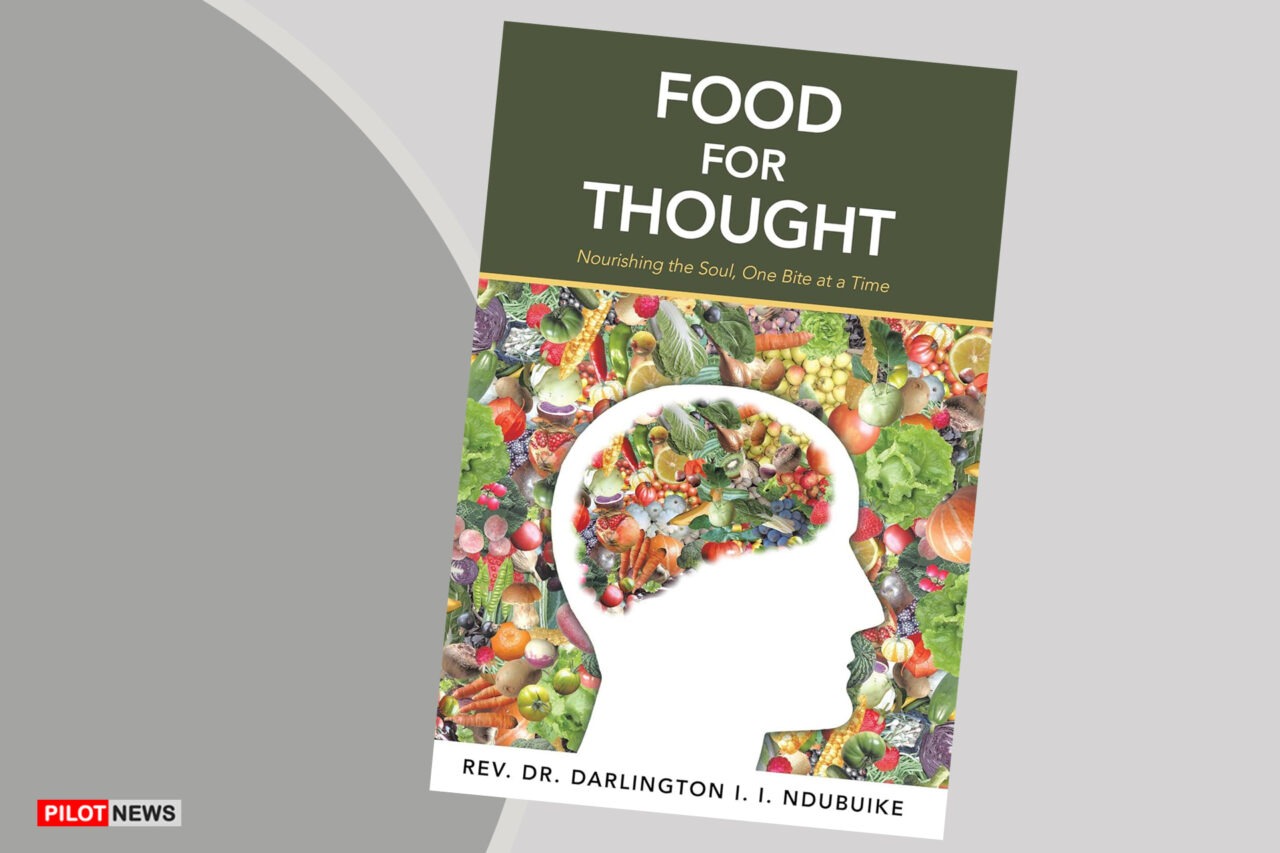
- Book Title: FOOD FOR THOUGHT: Nourishing the Soul, One Bite at a Time
- Author: Professor Rev. Dr. Darlington Iheonu I. Ndubuike
- Publishers: WestBow Press.
- Reviewer: Dr Emeaba O. Emeaba
- Pages: 220
In Food for Thought, Darlington Ndubuike transforms the produce aisle into a pulpit, finding in seventy fruits and vegetables a complete theology of the examined life; its trials, its silences, and its unexpected harvests.
 Consider, for a moment, the humble prune. Dismissed by most as a geriatric remedy, shriveled and graceless beside its more glamorous neighbors in the produce section, it is not the obvious vehicle for theological meditation. Yet it is precisely here, at the unglamorous end of the fruit bowl, that Professor Rev. Dr. Darlington Iheonu I. Ndubuike begins his ambitious, idiosyncratic, and occasionally arresting book of devotional reflections. “Before it becomes a prune,” he writes, “the plum undergoes a transformation; it is dried, its moisture removed, and its form altered. Though the process may seem like a loss, the prune becomes more concentrated, sweeter, and longer-lasting than the original fruit.” The pruning of the plum becomes, in Ndubuike’s telling, the pruning of the soul; God as Master Gardener, cutting away what comforts in order to cultivate what endures.
This is the central conceit of Food for Thought, and it is one the author pursues with a kind of joyful relentlessness across seventy chapters, each devoted to a different fruit, vegetable, or herb. From peach to peas, from chard to walnut, from kiwi to kale, each item in Ndubuike’s spiritual pantry yields a devotional lesson, a biblical parallel, and an acronymic framework for right living. The book belongs to a long lineage of nature-as-sermon writing; from the medieval Physiologus, which found moral instruction in the habits of real and fantastical animals, to the pastoral homiletics of the American evangelical tradition. But Ndubuike brings to the genre something distinctly his own: an exuberant fondness for wordplay, an autobiographical candor that occasionally startles, and a devotional warmth that persists even when the metaphors strain to the breaking point.
The book’s organizing principle is phonetic rather than botanical. Ndubuike pairs each food with a homophonic or near-homophonic English word or phrase: the peach becomes a meditation on the “pitch,” or the power of words; the kiwi prompts a reflection on “Can we?”—a question of communal possibility and spiritual unity; the walnut, with a brisk semantic pivot, becomes “Worry Not.” The raisin asks us to search for “reason” in the dry seasons of life; the lettuce implores us to “Let Us” choose reconciliation; the cantaloupe reminds us that we “Can’t Elope” from our responsibilities. Some of these puns land with the satisfying click of genuine insight. Others; the beet becoming “beats,” the corn becoming “con;” are more strained, their theological freight arriving at the station considerably ahead of any logical locomotive to carry it. Ndubuike is clearly aware that he is operating in the territory of the playful homily rather than the systematic treatise, and he generally deploys his puns with enough good humor to disarm objection.
What distinguishes Food for Thought from its devotional shelf-mates is the quality of Ndubuike’s autobiographical interjections. In a chapter ostensibly about chard—”charred,” in his reading, as a metaphor for transformation through trial—he pivots without warning into a searing personal memoir: his years as an international student in Houston, the hurricane that destroyed his workplace, the repossessed car, the miles walked before dawn from Stella Link Road to West Belfort, folding newspapers in the back of a pickup truck, shoulder still aching decades later. These passages are written with a plainness and precision that distinguish them sharply from the book’s more ornate homiletical moments. They arrest the reader because they are specific in a way that allegory rarely is; because they insist that the fire he describes is not only figurative. “I had a return ticket,” he writes. “I could have gone home. But I stayed. That was over forty years ago. What felt like the end was actually the beginning.” The chard chapter, in other words, becomes something more than a meditation on resilience; it becomes testimony.
The book’s theological framework is unambiguously evangelical and Protestant, rooted in the conviction that Scripture is the primary lens through which the natural world—and human experience—ought to be interpreted. Ndubuike cites Proverbs, the Psalms, the Pauline epistles, and the Gospels with the ease of long familiarity. His approach to biblical narrative is typological and hortatory: Joseph, Esther, Naomi, Gideon, Abraham, and Ruth appear as recurring figures, their stories pressed into service as analogues for contemporary spiritual dilemmas. This is a deeply traditional mode of Christian preaching, and readers already within that tradition will find the interpretive moves intuitive, even comforting. Those approaching from other perspectives—secular, interfaith, or from within Christianity’s more historically minded wings—may find the hermeneutic at once earnest and occasionally reductive. Ndubuike is not much interested in the ambiguities of biblical narrative, in the gaps and silences that have occupied critical scholarship for a century and a half. He reads for moral and spiritual direction, and he finds it consistently wherever he looks.
Structurally, the book follows a disciplined if somewhat formulaic pattern. Nearly every chapter concludes with an acronym that spells out the chapter’s food—the pecan yields PECAN (Positioned in Christ, Empowered by the Spirit, Called with Purpose, Anchored in Faith, Nourished by Grace); the peach yields PITCH (Pause Before You Speak, Intend to Build, Tell the Truth in Love, Choose Words Carefully, Honor God and Others). These frameworks are designed, one senses, for pedagogical application; for church small groups, Sunday school classes, sermons, and workshops. As pastoral tools, they are admirably efficient. As literary devices, they occasionally impose a tidiness on complexity that the preceding meditation has not quite earned. Life, as Ndubuike himself demonstrates when he is writing from memory rather than from schema, is rarely as categorical as an acronym.
The book’s range is its most impressive quality. In the space of a single volume, Ndubuike moves from modesty and bodily dignity (the citrus chapter’s meditation on “see-throughs” and discretion) to individuality and self-expression (the garlic chapter’s spirited defense of the “Gar-ilk,” those uncommon souls who carry bold presence without apology), from the communal ethics of the kiwi to the eschatological patience of wheat. The chapter on basil is perhaps the most quietly searching in the collection: Ndubuike warns against what he calls “basil living”—a life of safe, flavorless adequacy, the spiritual equivalent of the default herb—and invokes Esau’s sale of his birthright as its scriptural type. The Israelites in the wilderness, longing for the cucumbers and garlic of Egypt even after their miraculous deliverance, are pressed into service here as cautionary archetypes of comfort-seeking and diminished vision.
The final chapter, devoted to peas—peace—arrives with the warmth of a well-prepared meal’s last course. Peas, Ndubuike observes, “grow together in a pod, side by side, close-knit, and in harmony. They don’t compete for space; they share it.” It is a fittingly communal image with which to close a book that is, at its best, an invitation to a shared table; to the practice of attending carefully to the ordinary, of finding in the quotidian not distraction but direction.
Food for Thought is not a book without faults. It is uneven in texture, moving between passages of genuine spiritual depth and others that settle for the pleasant cliché. The acronymic scaffolding, useful as a preaching tool, can feel mechanical when encountered seventy times. And there are moments when the phonetic conceits require a suspension of credulity that the theological argument is not quite strong enough to support. But Ndubuike writes from a place of authentic vocation; he tells his readers, only half in jest, that he cannot cook, and that the Holy Spirit is the true chef of this volume, and that sincerity has a flavor of its own.
For readers willing to receive it on its own terms; as an extended pastoral exercise in finding sacred meaning in the ordinary world, written by a man who has walked miles in the dark and emerged with his faith intact; Food for Thought offers something genuinely nourishing. Ndubuike’s grandfather’s voice can be heard throughout: in the dedication to his grandson Lennox, he sets the book as “a table I’ve set with care, each page a dish seasoned with reflection, truth, and love.” That is, in the end, exactly what it is.
This book is available on Amazon (Click on Image).
_________
♦ Dr. Emeaba, the author of “A Dictionary of Literature,” writes dime novels in the style of the Onitsha Market Literature sub-genre.

- Kenya’s Dangote Paradox: Restricting African Traders While Welcoming African Billions - October 1, 2026
- When Nigeria and Italy led a $5 billion global education financing campaign - September 28, 2026
- 2026 Peace Day: Peace Begins in the Classroom - September 20, 2026